
From Hours to Minutes: How AI Transforms Document Management Efficiency

Ever spent hours just organizing documents? What if AI could do it all in minutes? Document management is upgrading from endless paperwork to a streamlined powerhouse.
In a study by Deloitte, organizations that implemented AI in document management saw a 20% increase in employee satisfaction due to reduced workloads and a more explicit focus on meaningful work. Efficiency, speed, and organization like never before.
Curious about the transformation with AI for documents? Read on!
The Traditional Challenges of Document Management
Outdated data management practices are now serious obstacles to productivity and accuracy. Employees spend countless hours getting through a labyrinth of files and looking for a necesary information which can include some mistakes due to manual management. These challenges impact individual productivity, organizational efficiency, and legal security. Below, we consider the three biggest hurdles of traditional document management.

Time-Consuming Manual Processes
Employees spend loads of time searching for information – this adds up to thousands of hours of lost productivity across an organization each year. In some cases, finding the right document may require flipping through hundreds of pages or folders. This inefficiency is exacerbated when employees don’t know exactly where to look, which results in delays in project timelines. This challenge doesn’t just waste time – it limits employees’ capacity to focus on high-value work and, as a result, directly impacts a company’s bottom line.
Risk of Human Error
Manual processes are particularly susceptible to human error, which results in misplaced, misnamed, or lost files. A single data entry mistake is a way to a cascade of issues – miscommunication, delays, or costly legal complications. These errors risk the accuracy of records and lower morale among employees. They are often required to spend extra hours double-checking and correcting mistakes. Human error impact efficiency; it also damages a company’s reputation if clients experience repeated mistakes. In many cases, correcting these errors is costly and time-consuming because it diverts resources from core business tasks.
Lack of Accessibility and Collaboration
Traditional document management methods are often siloed, so they limit employees’ ability of collaboration in real-time. Documents stored on local servers are difficult to access remotely; this hinders cross-team collaboration, especially for organizations with distributed teams or those transitioning to hybrid work environments. This lack of accessibility results in delays in decision-making, lower employee engagement, and inefficient workflows. The inability to seamlessly share, as a rule, slows down project timelines and reduces overall productivity.
Key Benefits of Using AI for Document Management
With automated document management, those pain points described above are disappearing in the nick of time. A custom AI assistant chatbot is a transformative force in streamlining and enhancing the way documents are handled, stored, and retrieved. An AI assistant is redefining document management in many ways. Here’s a closer look at the key benefits it brings to the table.

Cost and Time Savings
AI-driven document management reduces the time employees spend on mundane, manual tasks and ultimately lowers operational costs. AI allows businesses to reallocate resources to more strategic initiatives due to minimized human intervention in organizing, retrieving, and processing documents. Another important point is that AI-powered assistants simplify the onboarding process for new employees. Due to intuitive search and self-organization features, employees spend less time learning how to work with complex document storage systems. For example, an AI Chatbot can lead users to the documents they need and provide context or summary. This way it streamlines the training process for new employees and reduces onboarding costs associated with training document processing procedures.
Improved Collaboration and Productivity
Artificial Intelligence document management systems improve team collaboration by making documents easier to share and retrieve. With AI-based search and organizational features, employees spend less time searching for files and more time focusing on high-value tasks. AI-powered solutions integrate with popular productivity tools (like MS Teams etc). This enables seamless collaboration across platforms and departments. Plus, teams save time by reducing the need to interrupt managers or C-level colleagues for clarifications. With an AI assistant at hand, employees can ask questions directly, and they stay focused without disrupting others. In short, AI streamlines workflows and creates a more efficient, independent, and collaborative work environment.
Intelligent Search Capabilities
Retrieving documents becomes almost effortless due to the creation of a centralized document repository. Unlike traditional keyword-based search, AI search engines understand the context and natural language, meaning employees can search for information without having to remember precise terms or filenames. AI uses advanced algorithms to interpret requests and instantly pull relevant documents or data, even if the search terms are vague. This level of intelligence is a game-changer for employees who frequently need fast access to information. It reduces time spent searching and boosts overall efficiency.
Improved Accuracy and Compliance
AI minimizes human error in ways that manual processes simply can’t. For industries that rely on accurate, up-to-date, and error-free records (medicine, finance, and legal) digital transformation in document management brings accuracy. AI is also invaluable in tracking and enforcing compliance rules automatically within the regulatory compliance field. This means documents can be categorized, stored, and retained according to industry standards (e.g., HIPAA or GDPR) without requiring an employee to check each step. This way, AI reduces the risk of fines, audits, and reputational damage.
Real-World Applications and Use Cases
In industries where document-heavy operations are the norm, the efficiency gains from AI are measurable, transformative, and essential for staying competitive. Let’s look at how AI is redefining document management for modern companies – in consulting, architecture, and legal firms, where precise, rapid access to information is a competitive advantage.

Use Case for a Consulting Company
Consulting firms live and breathe data since they handle countless client documents, reports, and market research materials. This data flood is vital for producing insightful recommendations, yet sifting through it is a logistical nightmare. AI-powered search tools change the game by allowing consultants to instantly locate relevant case studies, reports, or prior project documents without the need for precise keywords or endless scrolling. Imagine a consultant preparing for a client presentation: with AI, they can retrieve case studies with a similar industry focus or financial model within seconds. Thus, automated document processing saves time and enhances the quality of insights delivered.
For example:
- Query: “Pull a summary of client feedback from the last quarter.”
- Answer: AI compiles & categorizes client feedback documents and provides summaries by client or project type, highlights key themes, and identifies areas for potential improvement.
Interesting: You can check how Broscorp created an AI assistant for a consulting company which greatly improved internal data management.
Use Case for an Architecture Bureau
Architecture firms juggle complex project files, from blueprints and client specifications to regulatory paperwork. The range of required standards (spanning zoning ordinances, building codes, environmental standards, fire safety protocols, and accessibility guidelines) involves sifting through dense and evolving information. This process delays projects and heightens compliance risks and inefficiencies within teams.
This challenge can be addressed by an AI-powered Assistant. Such solution reduces the time spent on this task by up to 70%, this way allowing architects to focus on their core work. The assistant provides instant and accurate insights on regulatory codes and comprehensive building standards.
For example:
- Query: “What are the requirements for cooling systems for a new building to ensure the comfort of users in Strasbourg?”
- Answer: Any new building in Strasbourg with cooling needs for user comfort must include a passive cooling system. If this is not technically feasible, a shared active cooling system at the building level may be considered, provided that 60% of the air conditioning needs are met by renewable energy sources.
Use Case for Legal Firms
Legal firms feature tremendous volumes and sensitivity in the documents they handle. Attorneys, paralegals, and administrative staff must manage case files, contracts, client documents, and court submissions, requiring rapid, precise retrieval under tight deadlines. An AI document management system caters directly to this need by tagging files intelligently. So a lawyer searching for precedent cases or specific contractual clauses can retrieve them immediately, without guesswork. This instant access allows legal professionals to focus on strategy and client advocacy rather than administrative tasks. It helps firms maintain a competitive edge in an industry where timing and precision are everything.
For example:
- Query: “What are the requirements for patent protection in the EU?”
- Answer: To obtain patent protection in the EU, an invention must meet three key criteria: novelty (must be new and not disclosed in prior art), inventive step (must not be obvious to a person skilled in the field), and industrial applicability (must be capable of being used in industry). The application must be filed with the European Patent Office (EPO) and undergo a thorough examination before the patent is granted.
Overcoming Potential Challenges with AI in Document Management
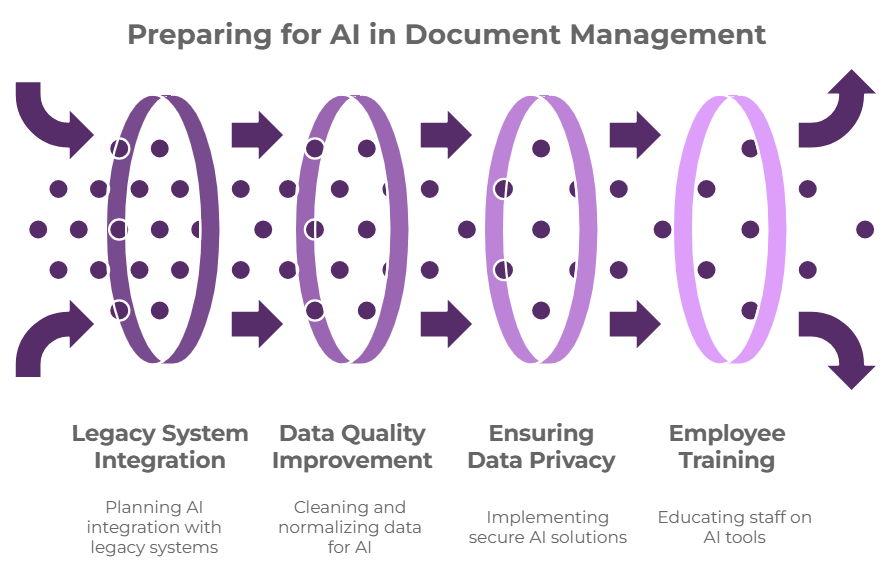
Let’s look at how it can minimize common AI and document management issues.
Quality of Data
AI systems rely heavily on high-quality, clean, and labeled data for training. If the data within the existing document management system is poorly structured, incomplete, or inconsistent, it could lead to inaccurate AI predictions and ineffective search results. This is particularly true for older or unorganized documents.
As a solution, companies need to invest in data cleaning and normalization before implementing AI. Effective AI training and accurate results strongly depend on a well-maintained data repository. Also, it is recommended to conduct regular audits and data quality checks to ensure AI systems perform optimally.
Data Privacy and Security
Privacy and security are top considerations when implementing artificial intelligence for document management. AI systems require access to large amounts of sensitive data, which raises concerns about data privacy and security. This is especially crucial for organizations dealing with confidential documents, such as legal contracts.
For this purpose, we at Broscorp recommend using chatbots built on Microsoft Azure, which provides end-to-end encryption and disables potential data leaks. Also, due to multi-layered protection, Azure-based chatbots keep the risk of unauthorized access at zero, meaning only authorized personnel or systems can retrieve, manipulate, or store sensitive data. So, AI for document management that prioritizes these elements offers companies the tools to protect sensitive information, uphold compliance, and minimize security risks.
Integration with Legacy Systems
Many organizations have legacy document management systems that were not built to support AI technologies. Integrating AI into these outdated systems is typically technically complex and costly. Legacy systems lack modern APIs or have incompatible data structures. This makes it difficult to implement AI tools without extensive customization or rebuilding of the system. To facilitate the process, businesses should assess their current systems and plan for incremental AI integration. In some cases, a better decision would be adopting a hybrid approach, where AI is integrated with new modules or platforms.
Employee Training
The most advanced AI and document management system won’t reach its full potential without employees trained to use it effectively. They may need guidance on new search functionalities, data input protocols, or how to interpret AI-generated insights. So, a strong training program should cover AI’s technical and practical aspects, as well as emphasize how it simplifies daily tasks and improves productivity. You can consider hands-on sessions, user-friendly guides, and ongoing support to build user confidence and ensure a smooth adaptation to AI-enhanced workflows. You will ease resistance ensuring that AI complements human roles, rather than replacing them.
How AI Will Continue to Transform Efficiency
AI is only scratching the surface of what’s possible in document management. Machine learning for document management is advancing at a light speed, so future AI systems will likely offer even more intuitive search capabilities, and fully automated compliance checks. What we can expect is document management solutions that retrieve information based on contextual cues and proactively suggest related documents or flag inconsistencies for review.
Enhanced natural language processing will allow users to interact with documents conversationally, searching for a seamless, intuitive experience. In the near future, AI-powered document management will go beyond simple automation to become a strategic tool for insights and data-driven decision-making.
Why Now is the Time to Embrace AI-Driven Solutions
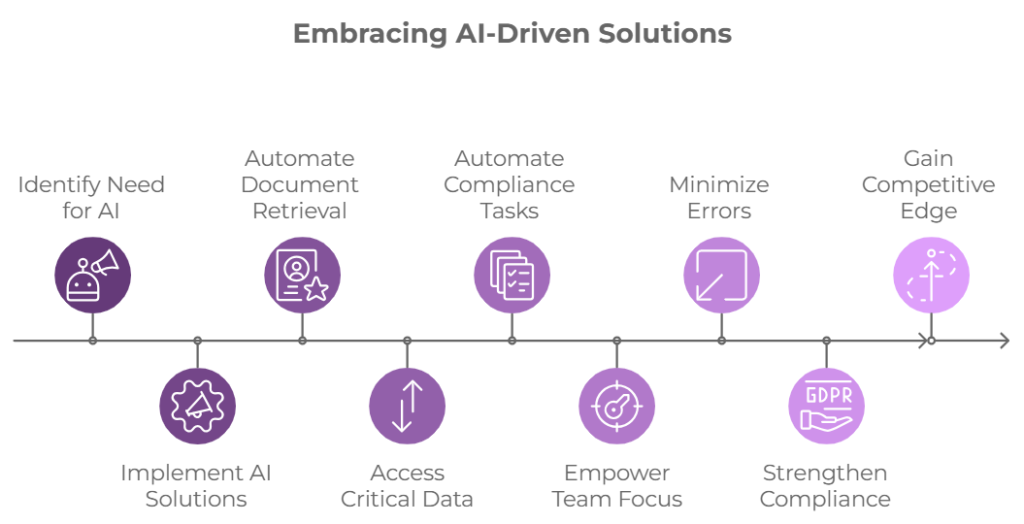
The world is moving faster than ever, and the pressure to stay competitive is real. AI-driven solutions are no longer a luxury – they’re the game-changer your business needs.
Imagine this:
- Hours spent on document retrieval, reduced to seconds.
- Critical data, available at the click of a button.
- Compliance tasks that once kept you up at night? Automated.
For companies embracing AI, these aren’t dreams – they’re today’s reality.
AI doesn’t just save time. It empowers your team to focus on what matters most, leaving repetitive tasks to automation. It minimizes errors, strengthens compliance, and brings productivity to levels traditional methods simply can’t reach. The longer you wait, the more significant the gap between you and your competition.
Don’t wait to see what it could do – tell your idea to Broscorp and start experiencing the future of efficiency today with an AI-driven document management solution.


