
How AI and Blockchain Are Redefining Decentralized Finance
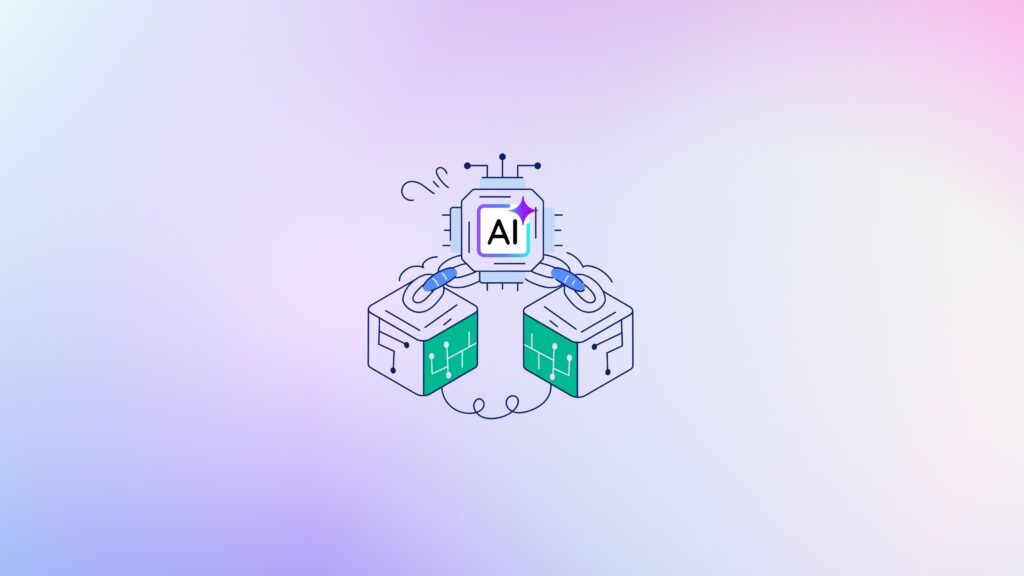
Decentralized finance (DeFi) transformed where finance happens: on-chain, without banks, via permissionless protocols. But it hasn’t transformed the way finance functions. Despite over $120 billion in total value locked (according to DeFiLlama) at the beginning of 2025, DeFi remains rigid, fragmented, and hostile to the average user. DeFi protocols operate on static logic, which limits their ability to adapt to volatile markets or individual user needs without manual intervention. This appears to be a trustless financial system that’s often unusable.
This is where AI enters as a structural upgrade. It brings real-time interpretation, anomaly detection, and continuous optimization to a system that desperately needs dynamism. Read on to figure out how AI and blockchain transform DeFi.
The foundation: where DeFi stands today and what’s missing
DeFi is built on the principle of eliminating intermediaries. Instead of relying on banks or brokers, it utilizes code in the form of smart contracts to facilitate transactions. These contracts are immutable, transparent, and live on public blockchains like Ethereum.
DeFi eliminates intermediaries through a stack built on three principles:
- Immutable smart contracts that enforce rules transparently.
- Self-custody that returns ownership to users.
- Composability that allows protocols to build on one another like financial Legos.
This foundation created a playground for innovation. But it also introduced structural constraints:
- Inflexible logic: Smart contracts can’t adapt without governance votes.
- Over-collateralization: Without dynamic risk models, lending protocols often require excess collateral, which limits capital efficiency.
- Systemic fragility persists due to the exploitation of flash loans, MEV, and oracle attacks, which are often detected and addressed reactively.

Despite the impressive $120B+ in TVL, DeFi engages only a sliver of global internet users. That’s not due to a lack of potential; it’s a usability and intelligence gap. Most users don’t want to adjust gas settings or parse 20 tabs of yield farming calculators. For DeFi to scale meaningfully, it requires more than just decentralization. The main “requirements” are cognition, adaptability, and usability – qualities AI can inject at the protocol, market, and user level.
Introducing AI in decentralized finance: from static logic to adaptive systems
To transcend DeFi’s rigidity, intelligence must be embedded at the protocol layer. AI’s value lies not in centralizing control, but in continuously observing, simulating, and optimizing complex systems. According to Spherical Insights, the blockchain technology that empowers the AI and DeFi market is expected to exceed $980 million in 2030.

AI’s value proposition is threefold:
- Interpretation: AI parses raw blockchain data (including wallet flows, gas trends, and contract activity) and distills it into actionable insights.
- Prediction: Machine learning models detect early signs of risk, from liquidity crunches to oracle drift to contract anomalies.
- Optimization: Smart contracts traditionally follow “if-this-then-that” logic. AI models can tune behaviors in real-time based on evolving conditions, from interest rates to liquidity routing.
Blockchain complements AI in return:
- Trustworthy data: On-chain data is timestamped, immutable, and tamper-proof, ideal for unbiased AI training.
- Transparent decision logs: Blockchain in DeFi records every AI decision and action immutably, creating a full audit trail.
- Decentralized computing: Networks like Bittensor and Gensyn enable AI model training without the need for centralized servers.
Together, blockchain and AI form a cognitive infrastructure for DeFi. AI makes DeFi adaptive, able to respond to real-world conditions. Blockchain makes AI accountable – this ensures transparency, traceability, and decentralization.
Practical AI use cases in DeFi
Across the ecosystem, AI becomes DeFi’s real-time interpreter that bridges the gap between raw blockchain complexity and informed action. It’s already embedded in some of the DeFi ecosystem’s most innovative tools:
- Spectral creates decentralized credit scores using AI to analyse wallet behavior and protocol history, enabling undercollateralized decentralized lending without requiring traditional identity verification.
- Numerai runs a decentralized hedge fund, sourcing AI models from thousands of data scientists and rewarding performance with crypto-based incentives. It’s crowdsourced cognition applied to predictive analytics in DeFi.
- Forta utilizes machine learning to detect protocol threats in real-time, flagging flash loan exploits and contract vulnerabilities before any damage occurs.
- Aave now applies AI-driven risk engines to dynamically adjust interest rates and liquidation thresholds, enhancing resilience during market volatility.
Use case: AI as DeFi’s Chief Risk Officer that detects and responds in real time
With high stakes come high risks: oracle drift, flash loan exploits, slippage cascades, and unexpected contract behavior. Most protocols react late, and AI can act early. Let’s consider AI capabilities across DeFi risk types below:
| Risk Type | AI Capability | Example Use Case |
| Flash Loan Exploits | Detect coordinated borrowing patterns & timing anomalies | Forta early-warning system |
| Oracle Manipulation | Monitor deviation across multiple feeds | Chainlink hybrid AI-calibrated oracles |
| Liquidity Gaps / Slippage | Predict thin pools and reroute trades across chains | FluidAI cross-chain routing engine |
| Collateral Risk | Recalculate real-time volatility and margin exposure | Aave dynamic LTV adjustment |
| Contract Fragility | Scan runtime behavior for edge cases & vulnerabilities | Quantstamp ML-based contract analysis |
The AI-driven CRO operates continuously: it analyzes behaviors, tests scenarios, and surfaces threats in real time. Instead of waiting for a governance proposal, the protocol adjusts its posture proactively.
This model enables:
- More resilient protocols that avoid cascading failures;
- Faster incident response without manual monitoring;
- Smarter capital allocation with lower default risk.
Use case: user-centric DeFAI with personalized agents and automation
The next wave of DeFi is more human. AI weaves deeper into DeFi infrastructure, so we witness the rise of DeFAI: decentralized finance that understands user intent, adapts dynamically, and communicates naturally.
Conversational portfolio agents come as DeFi’s answer to the robo-advisors of Web2. Instead of hunting through dashboards, users can now issue intent-based commands such as “Invest $500 in low-risk yield,” and AI agents evaluate on-chain yield strategies, protocol safety, historical volatility, and gas efficiency, all under AI-powered security.
Meanwhile, agentic fund managers are gaining traction. Protocols like Dexponent are piloting fully autonomous AI-managed vaults. These agents ingest on-chain data, simulate strategy performance, and dynamically rebalance positions based on market regimes – all while recording rationale and execution steps on-chain. Crucially, they’re not black boxes: governance interfaces let communities audit decision trails, adjust risk tolerance, or pause agent actions entirely.
This evolution shifts DeFi from a toolkit for devs to a service layer for users. Instead of being forced to learn how AMMs work, retail users can focus on what they want to achieve (e.g. capital growth, stability, or liquidity) and let AI handle the “how.”
Overview of real-world DeFAI trends
The convergence of AI and DeFi accelerates under pressure from real market needs and concrete technological shifts. Let’s consider what to expect in the future of DeFi.

1. Agentic finance is going mainstream
We’re entering an era of agentic finance where autonomous software agents reason, adapt, and act across financial protocols. These aren’t simple bots running fixed scripts. They’re learning systems that simulate scenarios, test outcomes, and make informed decisions in real-time. Many projects utilize AI to construct self-rebalancing portfolios and liquidity strategies that can be explained on-chain.
2. AI-governed vaults and treasuries
Experiments like Auto.gov are piloting decentralized treasuries governed by reinforcement learning agents. These AI systems adjust interest rates, risk thresholds, and liquidity incentives in real time while submitting rationale and logs for governance review. Communities can set constraints (e.g., max yield risk) but delegate micro-adjustments to AI. The key is that protocols can respond to markets on-chain in minutes, not weeks, without sacrificing transparency in blockchain.
3. Cross-chain intelligence layers
DeFi spans across Ethereum, Solana, Avalanche, and Layer 2s, resulting in increased complexity. Cross-chain AI routers such as FluidAI, Yelay, and Sui’s Perq act as bridge-aware strategists. They evaluate opportunities across networks and abstract away bridging, wrapping, and gas friction. A user deposits ETH and says, “Max safe yield.” The AI agent checks liquidity, slippage, volatility, and risk across chains and moves assets accordingly. Manual yield farming becomes obsolete.
4. Automated regulatory screeners
AI is now being applied to monitor chain activity for red flags – think of it as KYX (Know Your Everything). Tools building AI-driven transaction monitoring systems that flag suspicious patterns, wallet clusters, and blacklisted entities—without requiring central oversight. Protocols can embed these screeners into frontends or RPC layers to maintain decentralization while respecting jurisdictional boundaries.
5. Community-trained models
The next generation of DeFAI tooling won’t be built in silos. New protocols are experimenting with crowd-trained models. Thousands of users contribute strategy ideas, training data, or reward preferences, and the AI evolves in response to community input. Governance moves from parameter voting to model steering, where contributors shape how the AI thinks and adapts.
Designing AI for open financial systems: How do we trust autonomous systems in a trustless ecosystem?
DeFi was built to minimize human discretion. Now, we’re introducing adaptive AI models trained on probabilistic logic and subjective weighting. That creates tension and opportunity. The answer isn’t to resist AI, but to design it for visibility, accountability, and alignment.

1. Transparent logs: no black boxes
The number one critique of AI is its opacity. In traditional finance, algorithmic trading systems operate in black boxes with minimal oversight. That won’t fly in DeFi. Protocols like Gauntlet and Auto.gov are addressing this by logging every AI-driven adjustment, whether it’s a parameter shift, a liquidity allocation, or a flagged transaction. These logs are anchored on-chain, immutable, and traceable. Anyone can audit the “reasoning” of the model after the fact. That means:
- Why the liquidation threshold changed is recorded.
- When an anomaly was flagged, it was timestamped.
- The evolution of a risk score is provable.
This level of explainability fosters user confidence, attracts institutional interest, and paves the way for more advanced AI participation.
2. Governed autonomy: AI proposes, communities decide
Fully autonomous finance may sound seductive, but it’s a governance nightmare without proper constraints. The emerging best practice is bounded autonomy, where AI proposes changes, such as rebalancing a pool, shifting collateral ratios, or adjusting yield incentives. Token holders or DAO governors approve or veto these proposals based on contextual cues or automated thresholds. This maintains decentralization while ensuring the AI doesn’t exceed its mandate.
3. Privacy-preserving AI: zero knowledge meets ML
Another challenge is data privacy. If AI needs to analyze user wallets to personalize risk models or provide automated trading strategies, how can we preserve user anonymity? The answer lies in the fusion of zero-knowledge proofs (ZKPs), federated learning, and secure enclaves:
- With ZKPs, users can prove facts (e.g., sufficient wallet history) without revealing raw data.
- Federated learning allows AI to train across distributed nodes without centralizing sensitive data.
- Trusted execution environments (like Intel SGX) process encrypted data securely, even off-chain.
- Protocols like Zama, SnarkyJS, and Oasis Network are already experimenting with these combinations, creating a new class of AI that is both intelligent and confidential.
Conclusion
DeFi was born from code – immutable, trustless, and unstoppable. But code alone is brittle. What it needs now is cognition. AI doesn’t replace DeFi’s ethos. It reinforces it through insight, anticipation, and adaptability. It transforms smart contracts from static scripts into living systems that interpret context, assess risk, and respond dynamically. In the future, DeFi users won’t need to manage liquidity or memorise contract addresses manually. They’ll simply express intent, and intelligent, accountable systems will handle the rest. The promise of next-gen DeFi is this: autonomous finance – still decentralized, now more understandable.
At Broscorp, we help bring this vision to life. If you need custom blockchain development, reach out; we’re ready to build.


